alineod
A swarm control daemon — start, spawn, steer, pause and gather trees of sandboxed coding agents over HTTP + SSE, and keep them running through a crash.
alineod runs a swarm of coding agents, each in its own sandbox container, and gives you one HTTP API to drive the whole tree. A run starts with one agent:
curl -s localhost:4600/runs -H 'content-type: application/json' -d '{
  "spec": {
    "name": "lead",
    "harness": "pi",
    "harnessVersion": "1.2.0",
    "provider": "nvidia",
    "model": "nvidia/nemotron-3-super-120b-a12b",
    "env": { "NVIDIA_API_KEY": "${NVIDIA_API_KEY}" },
    "resources": { "cpu": "1000m", "memory": "2Gi" },
    "spawnDepth": 2,
    "maxAgents": 10
  },
  "prompt": "Clone github.com/expressjs/cors and install its dependencies."
}'
# { "runId": "r_3f9a1c20", "rootAgentId": "a_7b2e44d1", "state": "provisioning" }
Every agent runs and installs whatever it writes inside its container, never on your machine. ${NVIDIA_API_KEY}
is resolved from alineod's own environment, so the secret never travels in the request.
Quickstart →
client ── HTTP + SSE ──▶ alineod ── in-process ──▶ Agent SDK ──▶ OpenSandbox + PiChildren start where the parent is
curl -s localhost:4600/runs/r_3f9a1c20/agents -H 'content-type: application/json' -d '{
  "parentAgentId": "a_7b2e44d1",
  "spec": { "name": "reviewer-security", "...": "..." },
  "prompt": "Review lib/index.js for security issues."
}'
A child is a fork of its parent's live sandbox. The checkout, the installed packages and every file the parent wrote are already on its disk, so you clone a repository once and review it three ways at the same time — how runs and spawn trees work.
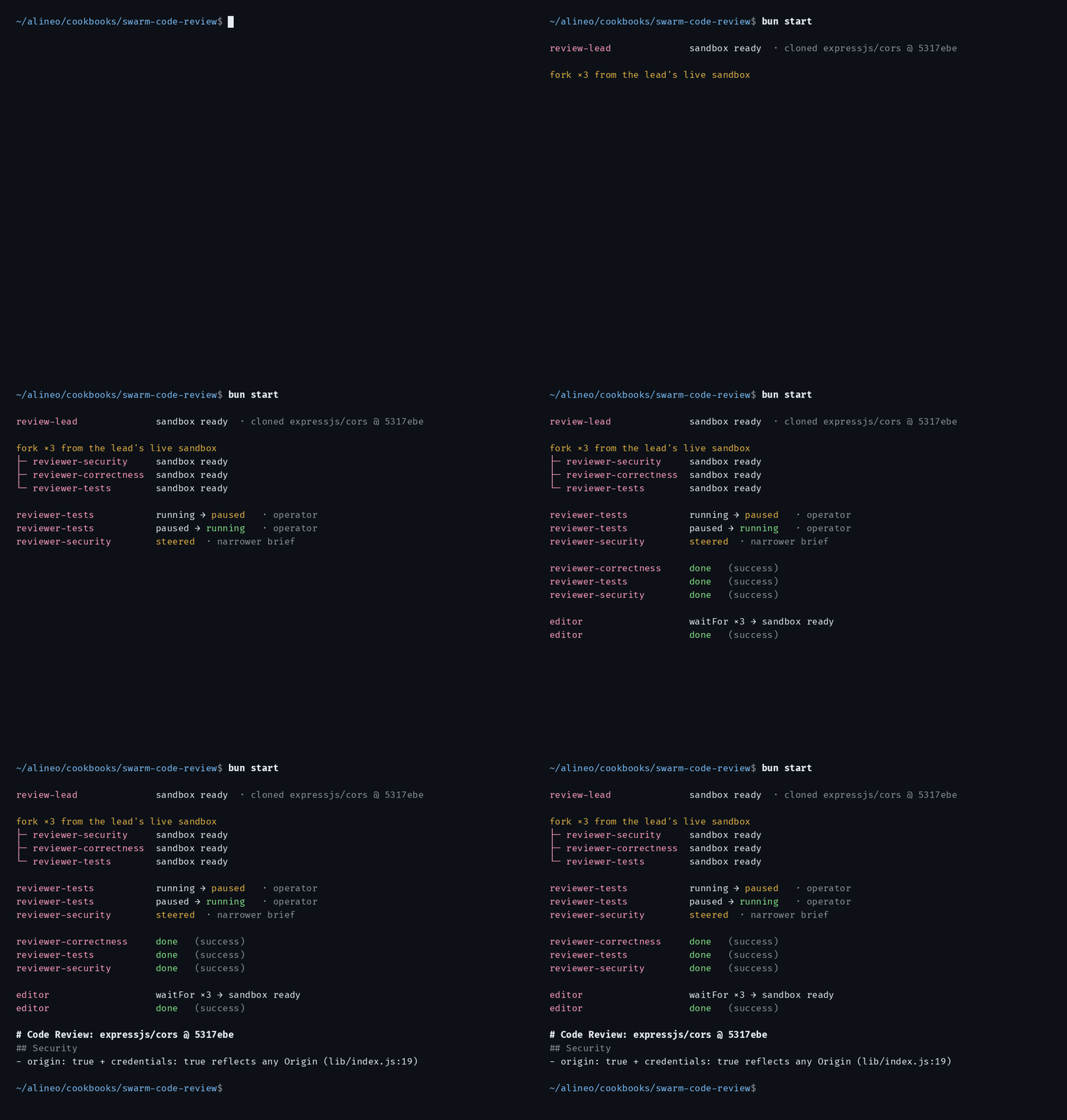
A sped-up replay of a real run — the swarm code review cookbook.
Gather without polling
Give a child a waitFor list and alineod holds it until those agents settle. Then it forks the child and writes
each result into its sandbox as /inputs/<agentId>.txt, with an /inputs.json manifest. The child's prompt reads
files. Your code doesn't wait on anything — fan-out and gather.
One stream for the whole tree
curl -N localhost:4600/runs/r_3f9a1c20/events -H 'Last-Event-ID: 128'Every agent in the run, present and future, reports on one Server-Sent Events stream: alineod's own lifecycle
events and each agent's tool calls and turns. Reconnect with the last id you saw, and every persisted event since
is replayed before live ones resume — events.
Steer, pause or stop — one agent or a subtree
curl -s -X POST localhost:4600/agents/a_7b2e44d1/steer -H 'content-type: application/json' \
  -d '{"message": "Security review is the priority now; drop performance.", "scope": "subtree"}'
A steer lands after the current tool call and before the next model call, so the agent keeps its context. With
"scope": "subtree" the parent gets your message plus a table of its children, and re-plans each child's work
itself. pause freezes containers, a whole subtree at once if you ask —
steering and pausing.
Budgets are enforced, not suggested
spawnDepth and maxAgents on the root spec bound the whole lineage. A spawn past either limit is refused with
a budget.denied event. An agent that decides to fork forty children gets as many as you allowed, and no more.
A failed turn can wait for you
By default a failed turn ends the agent failed. Set "onFailure": "ask" and it is held in blocked instead,
with its sandbox and its session intact, until you retry it with corrective text or stop it. A circuit breaker
holds any agent after three failed turns in a row, so a retry policy can't become a cost loop —
supervision.
Restart it whenever you like
alineod is crash-only. kill -9 it and start it again: agents run in containers, not as child processes, so an
in-flight turn keeps going while the daemon is down, and alineod reattaches to it on boot.
With "checkpoint": true on a spec, alineod also captures the agent's home directory — its session and the files
it wrote there — after every completed turn. If the container itself is gone — deleted, or left Exited by a
machine reboot — the agent is restored onto a fresh one and continues from its last completed turn. What survives what, exactly, is on one page:
the durability contract.
Memory outlives the sandbox
Every agent gets working and semantic memory keyed by its identity, not its container. It survives the sandbox being deleted, and a spawned child starts with a copy of its parent's — agent memory, and the memory model underneath it.
Drive it from chat
npx alineo-mcp exposes runs, spawns, steering and results as MCP tools, so Claude Code, Claude Desktop or Cursor
can run a swarm for you — MCP server.
Where this sits
alineod drives the Agent SDK in-process: the SDK is the library for one agent, alineod is the
control plane for a tree of them. If you only need one agent, start with the SDK. Because alineod's interface
is a wire protocol — an OpenAPI document at /openapi plus an event schema — any language can drive a swarm without
an SDK of its own.
Quickstart
Start the daemon, fan work out to three workers, and gather their results.
How it works
Runs, spawn trees, agent states, budgets and the ledger behind them.
API reference
Every HTTP route, and every event on the run stream.
Memory
Durable working, semantic and episodic memory, forked into every child.